
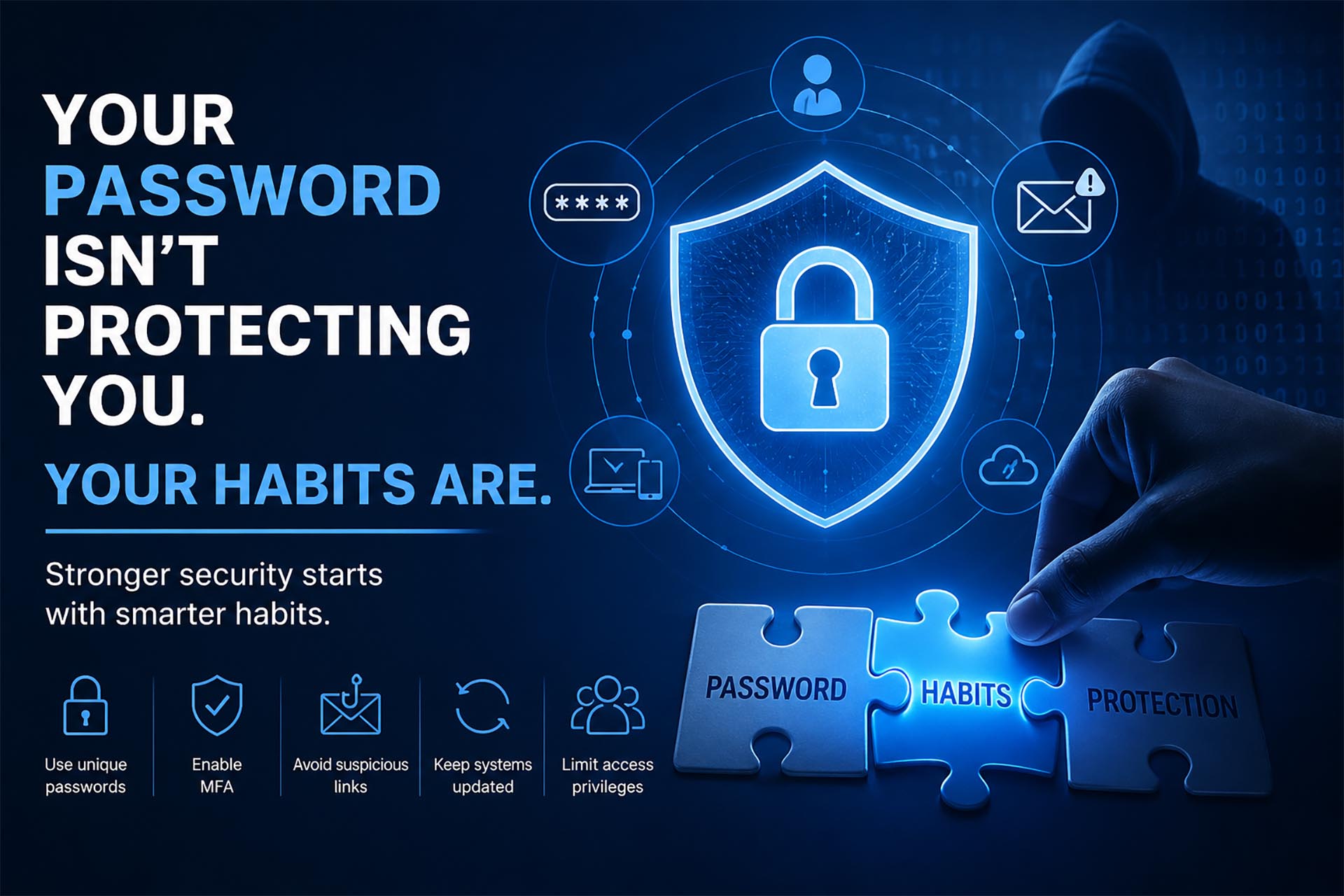
How Poor Security Practices Put Your Data at Risk
Discover why your password alone is not enough to protect you and how security habits play a critical role in cybersecurity. Practical steps to better safeguard your data.
In an era where cyberattacks have become a daily occurrence, many users still believe that a “strong password” is sufficient to keep them secure. The reality, however, is quite different: your security habits have a far greater impact on your safety than the password itself.
No matter how complex your password may be, weak digital habits will continue to expose your data to risk.
Why a Password Is Not Enough
Traditional security approaches emphasize creating strong passwords combinations of uppercase and lowercase letters, numbers, and special characters. However, modern cyberattacks rarely rely on brute-force methods to guess passwords.
Instead, attackers employ far more sophisticated techniques:
- Phishing attacks – tricking users into revealing their credentials
- Credential stuffing – leveraging previously compromised login data
- Social engineering – manipulating individuals into granting access
- Malware and keyloggers – capturing sensitive data directly from devices
In other words, the greatest vulnerability is no longer technology, it is user behavior.
Common Poor Security Habits
Many individuals and organizations unknowingly increase their risk through everyday actions:
1. Reusing the Same Password Across Multiple Services
If one platform is compromised, attackers will automatically attempt to use the same credentials elsewhere.
2. Ignoring Multi-Factor Authentication (MFA)
MFA is one of the most effective security measures available, yet it is often avoided due to perceived inconvenience.
3. Clicking on Suspicious Links
Phishing remains one of the most successful methods of compromise.
4. Failing to Update Software
Outdated systems often contain known vulnerabilities that attackers actively exploit.
5. Sharing Credentials Insecurely
Passwords are frequently shared via email or messaging platforms without encryption.
What Security Standards Say (NIST and NSA Guidance)
According to NIST Special Publications 800-171 and 800-53B, modern cybersecurity prioritizes:
- Access control
- Continuous monitoring
- User awareness and training
- Identity and access management
- Incident response planning
Additionally, NSA guidance emphasizes:
- Zero Trust architecture
- Principle of least privilege
- Ongoing user education and awareness programs
The conclusion is clear: security is a process, not a single tool.
How to Improve Your Security Habits
The good news is that small changes can significantly improve your security posture.
1. Use a Password Manager
Generate and store unique passwords for every account.
2. Enable MFA Wherever Possible
Even if your password is compromised, MFA provides an additional layer of protection.
3. Invest in Awareness and Education
Learn how to recognize phishing attempts and suspicious activity.
4. Keep Systems Up to Date
Regular updates patch known vulnerabilities.
5. Apply the Principle of Least Privilege
Grant access only to those who genuinely need it.
6. Use Security Tools
Antivirus, EDR, and monitoring solutions help reduce overall risk.
Your password is merely the first layer of defense, but it is not the most decisive one. Your daily habits determine whether an attacker will succeed or fail.
Organizations that invest in user awareness and foster a strong security culture experience significantly fewer incidents than those relying solely on technical controls.
In cybersecurity, a simple principle applies:
Technology protects systems, but habits protect people.
Digital Synergy Ltd is a forward-thinking technology company specializing in cybersecurity, cloud infrastructure, and AI-powered solutions. By combining strategic expertise with innovative technology, we help organizations build secure, scalable, and future-ready digital ecosystems.
For more information, visit digital-synergy.eu
