
Independent NIS2 Assessments Improve Risk Visibility
Discover why your password alone is not enough to protect you and how security habits play a critical role in cybersecurity. Practical steps to better safeguard your data.
As organisations across the European Union prepare for NIS2 compliance, many initially assume that implementation can be managed internally by existing IT, Security, Risk, or Compliance teams.
While internal expertise is essential, NIS2 is far more than a regulatory exercise. It requires organisations to establish and maintain governance structures, cybersecurity controls, risk management processes, incident response capabilities, supply chain security measures, and executive oversight mechanisms.
For many organisations, engaging an experienced NIS2 implementation partner provides a faster, more efficient, and lower-risk path to compliance while simultaneously strengthening long-term cyber resilience.
The most successful NIS2 programmes combine internal business knowledge with external expertise, enabling organisations to accelerate implementation, identify critical gaps, and build sustainable operational resilience.
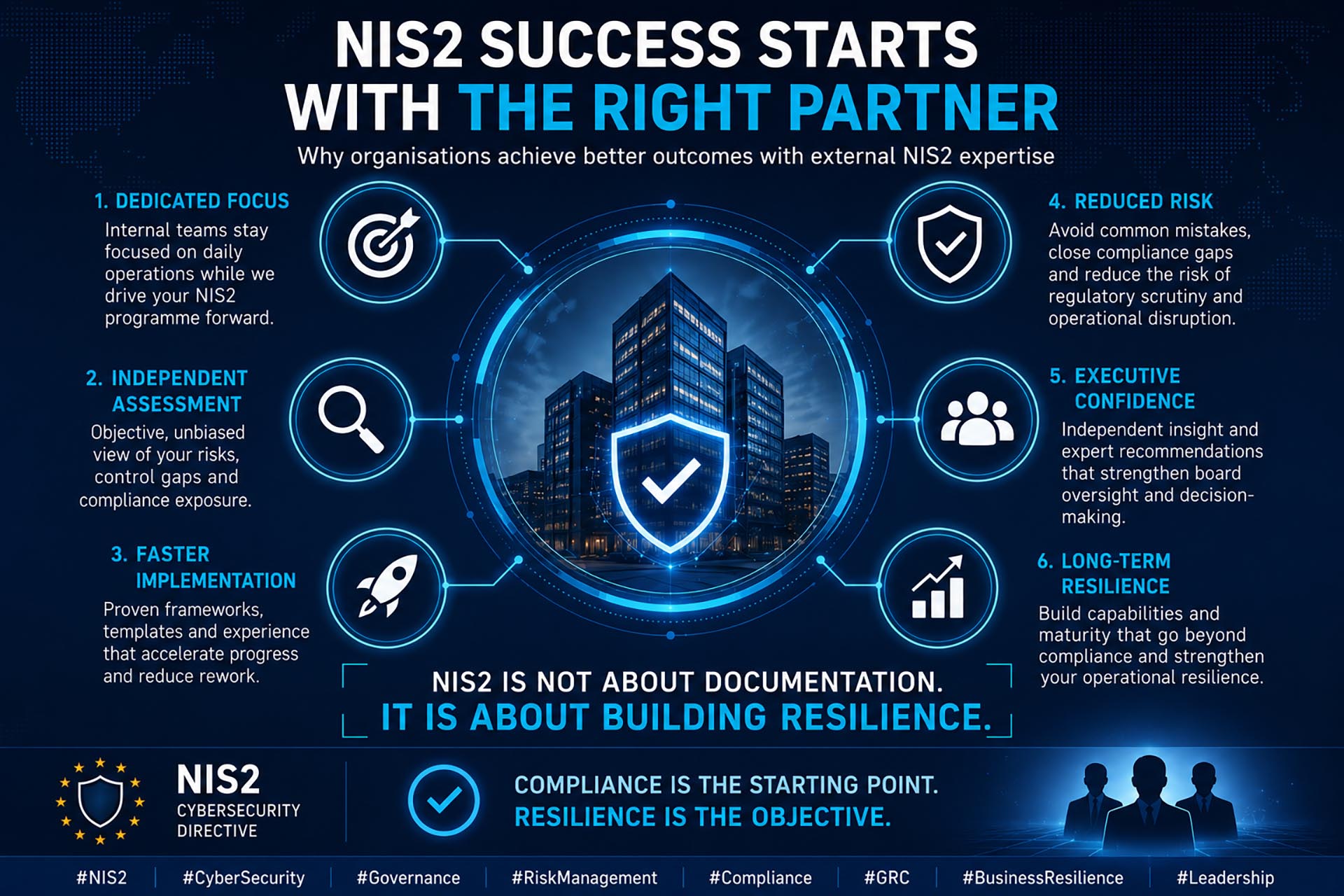
1. Internal teams already have full-time responsibilities
Most organisations are operating with limited resources.
IT teams are focused on maintaining critical systems.
Security teams are managing threats and incidents.
Leadership teams are driving business priorities.
Adding a complex NIS2 programme on top of existing responsibilities often leads to delays, competing priorities, and incomplete implementation.
An external partner brings dedicated focus and accountability to the programme, helping ensure momentum is maintained and objectives are achieved.
2. Independent assessments provide greater objectivity
One of the most overlooked challenges in compliance initiatives is internal bias.
When teams assess processes they have designed and operated themselves, gaps can be unintentionally overlooked or underestimated.
An experienced external advisor brings an independent perspective and can objectively identify:
- Governance weaknesses
- Security control gaps
- Risk management deficiencies
- Third-party risk exposures
- Areas requiring immediate attention
This enables leadership to make decisions based on an accurate picture of organisational risk rather than assumptions.
3. Experience across multiple organisations accelerates success
Internal teams understand their own environment extremely well.
External specialists bring something different: exposure to dozens of organisations, industries, and regulatory environments.
They have already seen what works, what fails, and where organisations typically struggle.
This experience allows them to introduce proven approaches, practical solutions, and lessons learned that can significantly reduce implementation risk and accelerate progress.
4. Faster path to compliance and operational maturity
Many organisations spend months trying to define:
- Risk management frameworks
- Incident response processes
- Supply chain risk management programmes
- Governance structures
- Compliance reporting mechanisms
Experienced external partners typically bring established methodologies, templates, control frameworks, and implementation experience.
This reduces time spent reinventing processes and allows organisations to focus on execution rather than starting from scratch.
5. Stronger support for executive leadership
NIS2 places clear accountability on senior management and governing bodies.
Executives must understand cyber risks, oversee mitigation efforts, and demonstrate appropriate governance.
Independent assessments and recommendations often carry greater weight with leadership because they come from specialists who are not influenced by internal organisational dynamics.
This helps boards and executives make informed decisions with greater confidence.
6. Better long-term business value
Some organisations view external support as an additional expense.
The more relevant question is: what is the cost of getting NIS2 wrong?
Consider the impact of:
- Delayed implementation
- Misallocated resources
- Compliance gaps
- Rework and remediation efforts
- Regulatory scrutiny
- Operational disruptions
In many cases, leveraging external expertise reduces overall cost by helping organisations avoid common mistakes and focus investment where it delivers the greatest value.
The Bottom Line
NIS2 is not about producing policies or completing a compliance checklist.
It is about demonstrating that your organisation can effectively identify, manage, and respond to cyber risks while maintaining resilient operations.
The organisations that achieve the strongest outcomes are often those that combine internal business knowledge with the experience, objectivity, and specialised expertise of a trusted external partner.
Compliance may be the starting point, but resilience is the real objective.
Digital Synergy Ltd is a forward-thinking technology company specializing in cybersecurity, cloud infrastructure, and AI-powered solutions. By combining strategic expertise with innovative technology, we help organizations build secure, scalable, and future-ready digital ecosystems.
For more information, visit digital-synergy.eu
