
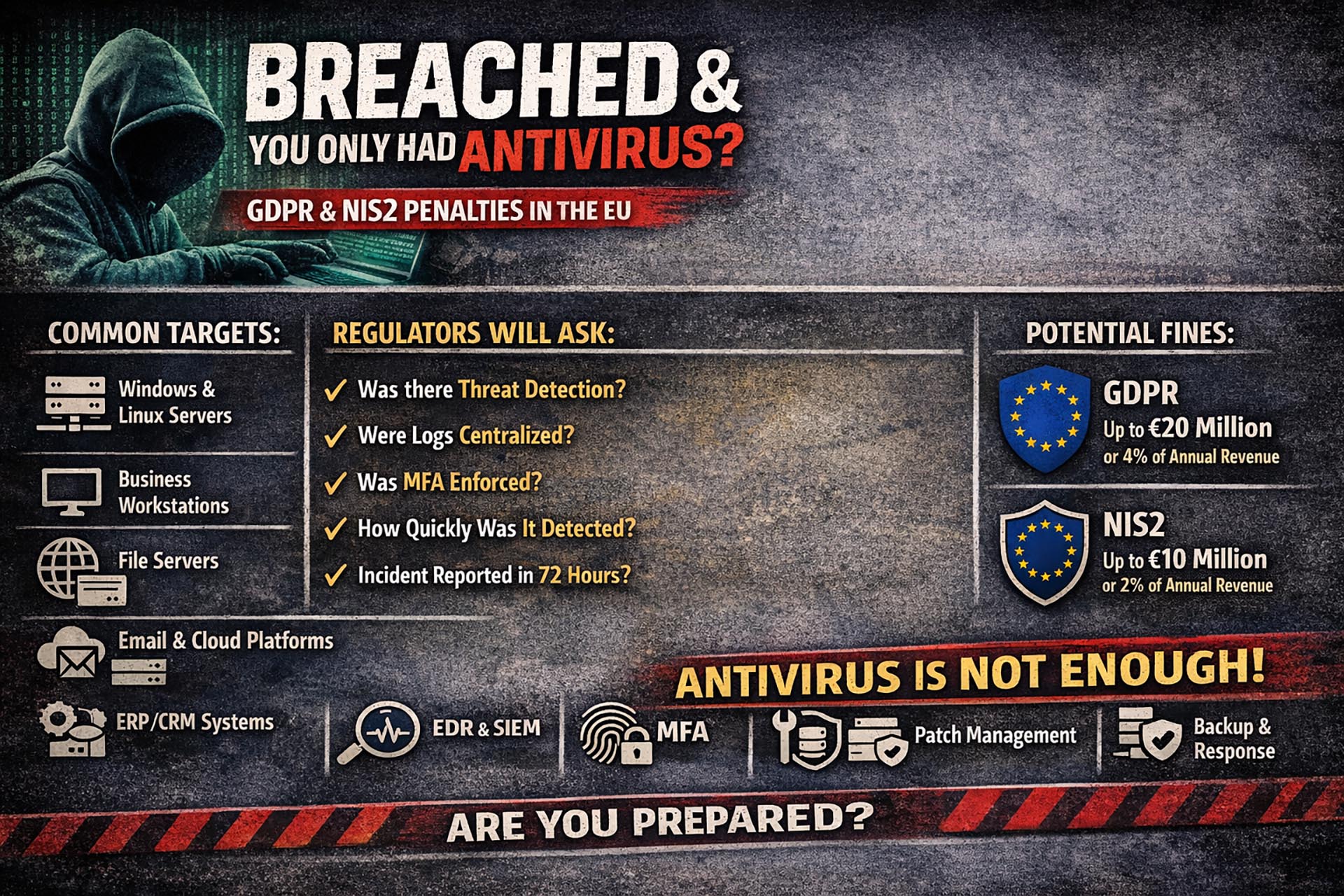
Your Company Was Hacked and You Only Had Antivirus? Potential Penalties Across the European Union
This applies to servers and business workstations, not only large enterprise systems
Many organizations across the European Union still assume that antivirus software alone is sufficient to protect servers and business workstations. In practice, if a security incident occurs and it is determined that adequate technical and organizational security measures were not implemented on Windows workstations, Linux servers, file systems, email platforms, or web servers, supervisory authorities may impose significant financial penalties.
The key point is this: the issue is not that an organization was compromised, but that appropriate security controls were not in place across servers and endpoints.
When penalties are imposed
Penalties are most commonly considered when there is a compromise of:
- Business Windows 10 and Windows 11 workstations
- Linux, Ubuntu, or Debian servers
- Windows Server environments
- File servers and NAS systems
- Web servers (Apache, Nginx, IIS)
- Email systems or cloud accounts
- ERP and CRM platforms
- Virtualization infrastructure
Regulators typically assess:
- Whether centralized logging from servers and endpoints exists
- Whether threat detection capabilities were in place
- Whether multi-factor authentication (MFA) was implemented
- Whether continuous security monitoring existed
- Whether an incident response plan was defined
- Whether audit logs were maintained
- How quickly the incident was detected
- Whether the incident was reported within 72 hours
If an organization relies solely on antivirus protection across servers and endpoints, this is often considered insufficient.
GDPR penalties across the European Union
If personal data is compromised from servers or workstations, the General Data Protection Regulation (GDPR) allows for administrative fines of:
- Up to €10 million or 2% of total global annual turnover
- Up to €20 million or 4% of total global annual turnover (for more serious violations)
Supervisory authorities evaluate:
- Whether appropriate security measures were implemented
- Whether monitoring and detection capabilities existed
- Whether audit logs were available
- How long the attacker had access to systems
- Whether the breach was reported within the required timeframe
- Whether an incident response process existed
The absence of logging, monitoring, and detection significantly increases enforcement risk.
NIS2 Directive: Security obligations for organizations in the EU
The NIS2 Directive introduces mandatory cybersecurity requirements for organizations across multiple sectors, including:
- IT and digital services
- Cloud and hosting providers
- Managed service providers (MSPs)
- SaaS platforms
- Financial services
- Healthcare
- Energy
- Transport
- Digital infrastructure
- Essential and important entities
NIS2 requires security controls across:
- Servers
- Workstations
- Network infrastructure
- Cloud environments
- Applications
- Administrative accounts
Potential penalties under NIS2 include:
- Up to €10 million
- Or up to 2% of global annual turnover
- Additional supervisory measures and regulatory oversight
- In certain cases, management accountability
Antivirus alone on servers and endpoints does not meet NIS2 security expectations.
Minimum controls typically expected by regulators
To demonstrate appropriate security measures, organizations are typically expected to implement:
- Endpoint Detection and Response (EDR) on servers and workstations
- Centralized logging and log retention
- SIEM or security monitoring capabilities
- Multi-factor authentication for administrators and email access
- Patch and vulnerability management
- Backup and recovery procedures
- Documented incident response process
- Privileged access control
A full Security Operations Center is not required, but organizations must maintain visibility across servers and endpoints.
A typical high-risk scenario
An organization has:
- Antivirus only on endpoints
- No centralized logging from servers
- No SIEM or monitoring
- No multi-factor authentication
- No continuous security visibility
A ransomware attack or data breach occurs.
Regulators will ask:
- How was the incident detected?
- Where are the server audit logs?
- How was lateral movement prevented?
- How long did the attacker have access?
If the organization cannot provide answers, regulatory penalties become significantly more likely.
Antivirus alone is no longer sufficient to protect business workstations and servers.
Following a security incident, the absence of logging, monitoring, and detection capabilities may become a decisive factor in regulatory enforcement across the European Union.
Organizations operating in the EU should implement at least baseline security monitoring across servers and endpoints to reduce legal, operational, and financial risk.
Sources and EU regulatory references
General Data Protection Regulation (GDPR)
https://eur-lex.europa.eu/eli/reg/2016/679/oj
GDPR Article 32 – Security of processing
https://eur-lex.europa.eu/legal-content/EN/TXT/?uri=CELEX:32016R0679
GDPR Article 33 – Notification of a personal data breach
https://eur-lex.europa.eu/legal-content/EN/TXT/?uri=CELEX:32016R0679
NIS2 Directive (EU) 2022/2555
https://eur-lex.europa.eu/eli/dir/2022/2555/oj
ENISA – NIS2 guidance
https://www.enisa.europa.eu/topics/nis2
European Commission – NIS2 Directive overview
https://digital-strategy.ec.europa.eu/en/policies/nis2-directive
ENISA Cybersecurity Guidance
https://www.enisa.europa.eu
Digital Synergy Ltd is a forward-thinking technology company specializing in cybersecurity, cloud infrastructure, and AI-powered solutions. By combining strategic expertise with innovative technology, we help organizations build secure, scalable, and future-ready digital ecosystems.
For more information, visit digital-synergy.eu
